
Want to send a powerful message? Start by standing tall. 70-93% of communication is non verbal, and posture speaks louder than words. Now do you really want to understand how to improve posture; or do you just want a few quick fix exercises that will work short term?
I can do both.
Ummm, I’m in a hurry. Just give me the exercises.
This is not how to improve posture
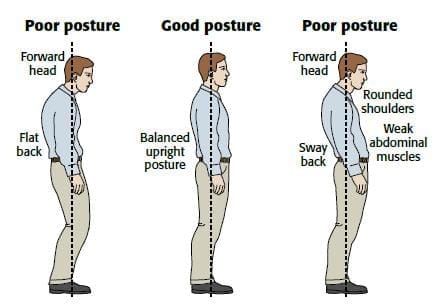
Bad posture means a forward tilting head, rounded shoulders and a stooped spine. It’s widely believed this happens because muscles on the front side of the body are overworked and tight. Therefore, stretching those tight front chain muscles, in addition to engaging/exercising rear chain muscles (with pull exercises like rows) will fix your posture.
True: Engaging muscles on one side of the body inhibits muscles on the opposing side; this is called reciprocal inhibition (and it is a great tool to deepen stretches).
It works when you’re consciously trying to stand up straight, but is NOT a long term postural fix.
Okay, I get it. Give me the hard answer.
Alright, thought you’d never ask.
Your Brain: The Ideal Employee
Bill Gates described his ideal employee as naturally lazy. Why hire that guy? Because the lazy guy streamlines systems: they find the most efficient way to do something to avoid work. Your brain, by that measure , is an ideal employee.
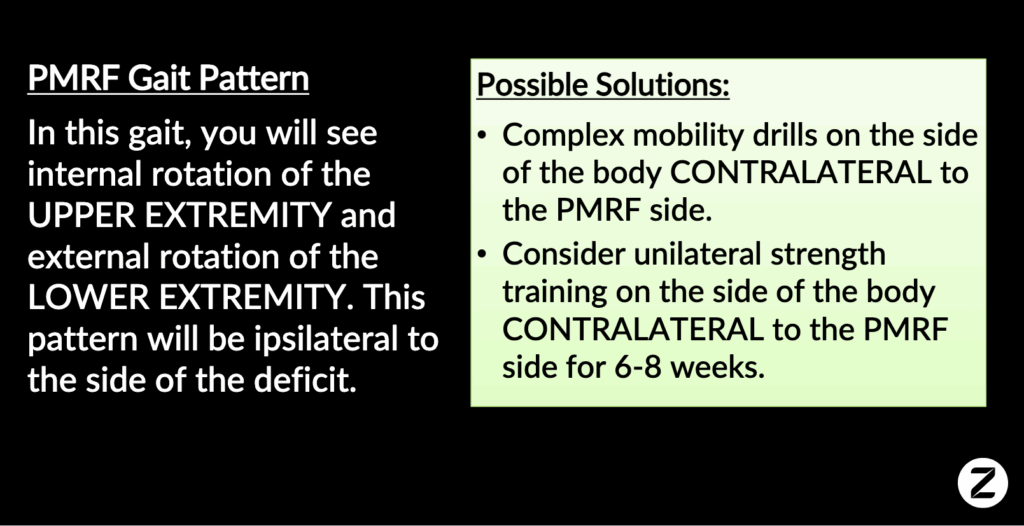
Your autonomic nervous system subconsciously performs millions of tasks every minute. Posture is one of those tasks. Posture is under reflexive muscle control. i.e. it is something your autonomic nervous system (ANS) regulates without your thinking about it (thanks Lazy Brain). The part of the brain most responsible for your posture, by and large, is the PMRF.
A lot of people have “dysfunctional output” from their PMRF, and their posture suffers as a result. If you only walk forward in a straight line, sit at a desk, sit in your car, on your sofa and stare at screens all day your lazy brain will adapt your body (poor PMRF function) to do that more efficiently. The lazy brain is creating a shortcut to your preferred posture.

Activate your PMRF to meaningfully improve posture.
Is my PMRF is functioning well?
Let’s have a look. PMRF function shows up in gait. Film yourself walking, then look for 2 signs:
- Duck toed (toes point out)
- Inwardly rotated arms (you can see your palms as you walk away)
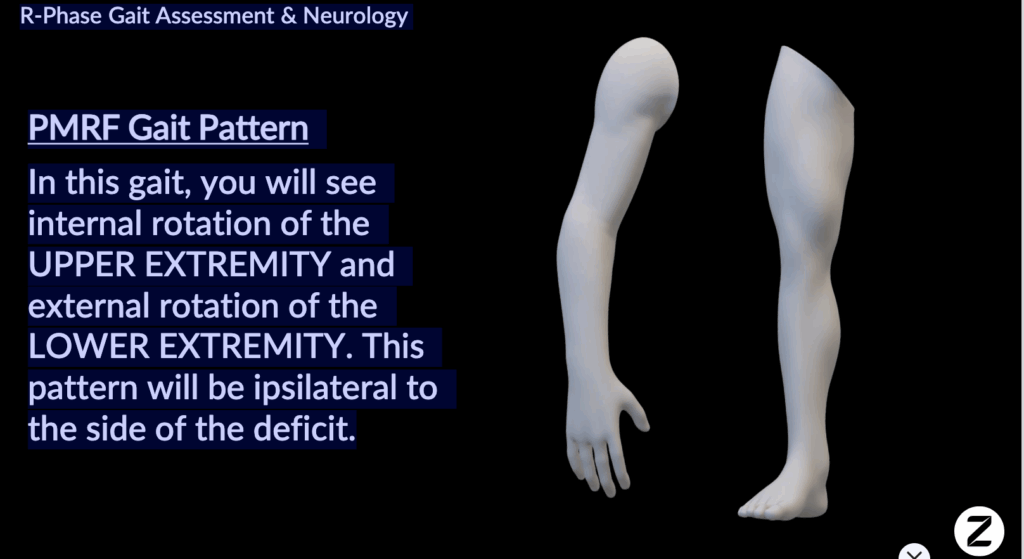
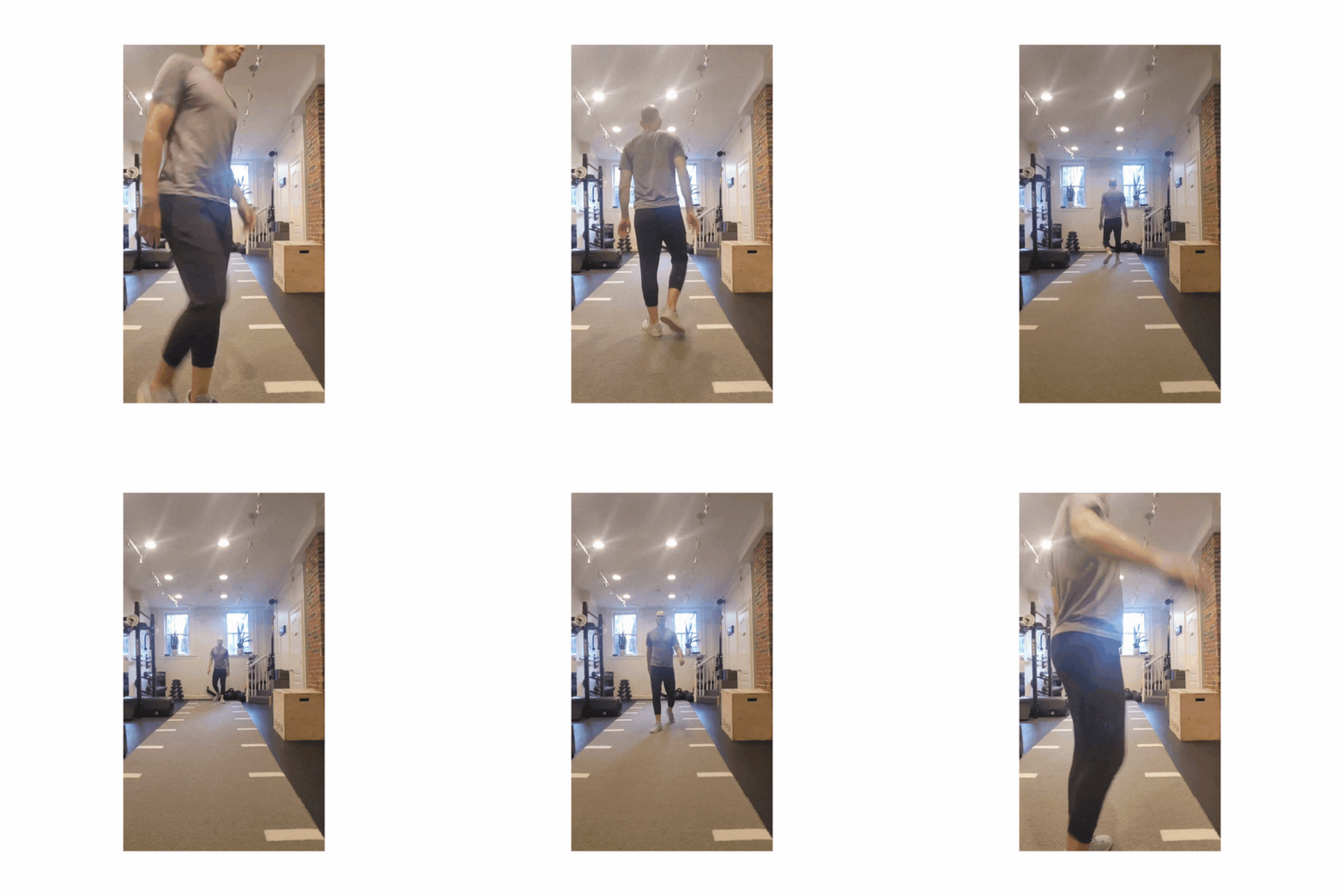
If you walk like this then your PMRF isn’t working optimally.
2 Quick notes:
- There is a right and left side PMRF. You may walk neutrally on one side whilst showing a PMRF gait on the other.
- PMRF gait is very common.
How to actually improve your posture
Let’s quickly review what happens in the brain when we make a voluntary movement (like picking up a coffee cup with your right hand). When we reach for the coffee cup:
- The left side of the frontal lobe initiates right hand movement.
- The right side of the cerebellum controls the movement.
- The left side PMRF reflexively stabilizes the body to assist the movement.
If you move your right hand, as has been noted, you activate your left side PMRF. So if you want to activate/improve your left PMRF you should move the opposite (R) side of the body; perhaps training that one side of the body exclusively for 6 to 8 weeks to increase activation in the pmrf.
Well, that escalated quickly
Sorry to get all complicated on you, but we’re playing chess not checkers. Let’s review:
- You have bad posture
- You film yourself walking
- You notice a right side PMRF gait (toes out, palms in) pattern
- You do complex movements with the left side of your body for 6-8 weeks
- Your right side PMRF is activated as a result
- Increased activation of right side PMRF improves posture
- You walk tall
One last question: Complex movements?
We are contralateral bipeds. Thats a fancy way of saying that in gait as the left leg moves forward it is joined by the right arm (and vice versa). Left and right move together as we walk. They are coupled. Because they are constantly firing together movement on the one side of the body has an (oft inverted) effect on muscles near the coupled joint from the other side. Look below and you’ll see which joints are coupled together (knee/elbow, wrist/ankle). The PMRF plays an important role in signaling/coupling these joints.
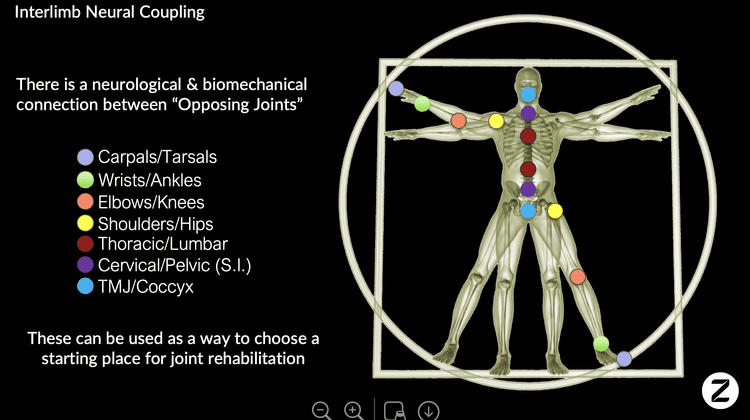
Opposing Joint, opposing motion
If you’re walking in a PMRF gait move the neurally coupled joint on the other side. The increased activation of your PMRF will improve posture and gait on the affected side.
Every joint in the body is coupled with one on the other side of the body. These joints are similar in function and their movement maps live closely together in the brain.
The two places where poor posture presents are the shoulders and the hips. Try shoulder and hip circles to activate the faulty PMRF or…
Do Yoga
I teach dozens of these complex mobility drills to clients every day. The movements of basically all of these drills are present in some form in a yoga practice.
Yogis, for the most part, have great posture. Peak sport and spine physical therapy write, “Many people wonder, “does yoga improve posture?” The answer is a resounding yes! When practiced correctly, yoga can be a powerful tool for improving posture and overall spinal health. This ancient practice not only enhances flexibility and strength but also promotes better alignment and body awareness.”
Also, my own posture improved dramatically when I began seriously practicing yoga.
Ummmm, I don’t love yoga.
We can also try staring into space.
Huh?
Your body follows your eyes
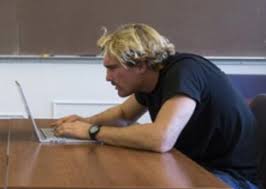
What cues are you constantly giving your brain? Stand up. Find a mirror. Stare at your phone 12″ from your face. Read a few paragraphs or watch a quick insta video. Now observe your posture in the mirror. I’m betting your slouched forward to pay attention to the screen. Our vision is our most important, most dominant sense. Staring at things 6 inches in front of our faces (ahem Cell phones, ahem) can lead to slouched posture.
Remember this if you’re skiing or mountain biking (if you stare at the tree you’ll see it close up- trust me). When you stare at something close to you your eye muscles constrict to allow better focus on close objects. To aid your eyes your head will jut forward, your shoulders will round and your spine will flex forward. Focusing on something extremely close to you gives you bad posture. Is this your default?
Let’s try the opposite. Stand up- find the mirror. Now stare at something far away on the horizon for 20-30 seconds. Re-check your posture. Better? When your eye muscles widen and you look ahead your shoulders roll back, your spine gets tall and your head sits atop your neck.
Trapped at a desk staring at a screen all day? Schedule in breaks where you stare off into the distance. Tell your boss it’s posture work, not daydreaming.
Wow… that worked.
Great. Try walking around like that.
Any other cool fixes?
Hang in there. I have one more fix.
Hanging. As in dead hang, i.e. grab a bar and dangle.
“A common tip for good posture is to pull your shoulders back and down. This can help correct your posture temporarily. But strengthening core muscles, as dead hangs do, is critical for improving your posture over time. A strong core helps keep your spine aligned, which may prevent slouching during everyday activities. Plus, dead hanging also works back muscles, such as the lats and traps, which are essential for an upright posture.”
Hanging also increases grip strength which has been found to be corollary with long life span.
In sum
Your brain controls posture autonomically. Change your brain to change your posture.
Complex movement drills, or yoga (which is basically a full body complex movement drill), are the tools to change our brains.
Wow. I need a nap.
Sorry to go all neuro on you there. I had to break out the ol’ text books to write that one. You were probably hoping I’d give you a few exercises, tell you to stretch your hips and get on with it, but as Tony Robbins famously said ‘happiness is progress.’ Improvement brings hope. It’s better to write about the complex stuff than to feed you click bait rife with false hope that one or two exercises will do the trick.
I hate that answer, but you’re right.
Having the right idea about how to improve posture could lead to that progress, and thus greater happiness. That kind of happiness you communicate powerfully; effortlessly; non verbally.
People will stare and wonder, ‘are you happy because your posture is great, or is your posture great because you’re happy’?
Only one way to find out. Let’s work on that posture.