
Phantom pain? Chronic soreness? Low energy? Lack of focus? Could it be you have a fueling problem?
All of these very general symptoms above can be the result of lack of oxygen. Your body receives oxygen from two primary resources: nutrition and breathing. Let’s just ignore the nutrition aspect for a minute and focus on your breathing.
Is there a way to assess whether or not we’re breathing optimally? Yes. It’s easy.
Optimal Breathing
Alright- what’s hurting? What’s sore? How is your focus?
If it’s your knees do a few air squats. Shoulder? Do a quick range of motion test.
How’d it feel? Give it a score.
Alright- let’s check under the hood.
- Exhale all the way.
- Then hold your breath on empty lungs.
- Now do a safe (non painful) exercise of your choice. Any exercise will do.
- Do as many reps as you can until you HAVE to take a breath.
- Alright take that next breath. Shake it off for a few seconds. Now retest your knees, shoulder, mental acuity.
Feeling better? If you are then chances are you’re over breathing, and we’ve identified a potential solution to your problem.
What devilry is this?

See the oil and water? They don’t mix. That’s kind of how CO2 and Oxygen sit in your hemoglobin.
We want that Oxygen out of the bloodstream and into your muscles, brain, etc. The level of CO2 (oil) has to rise and push that O2 (water) out of your cell.
When you held your breath and exercised for a few reps your body created more CO2 (olive oil); and by holding your breath you kept it in the cells. That CO2 pushed more O2 (water) from your bloodstream and into your cells. That O2 fueled your body. So by holding your breath your muscles got more Oxygen.
Breathing less got you more O2. Trippy.

Breathing is a skill
What does one do if they retested well after creating air hunger?
Easy. Take a seat. Look at a clock. Breathe 5 times a minute (the ideal number of breaths.) for a few minutes.
You’ll feel better almost instantly.
And now for a segment we call…
You can lead a horse to water, but you can’t make it drink.
I have a client, let’s call him Ron, with severely limited shoulder mobility. When asked to raise his right arm up, he can’t get past horizontal. We do some air hunger exercises and subsequently Ron raises his arm 20-30 degrees higher. So now I break out the big guns: I put him in the oxygen deprivation mask I bought on amazon. This is a mask that reduces the amount of oxygen you can breathe in, and makes you look like Bane from Batman.
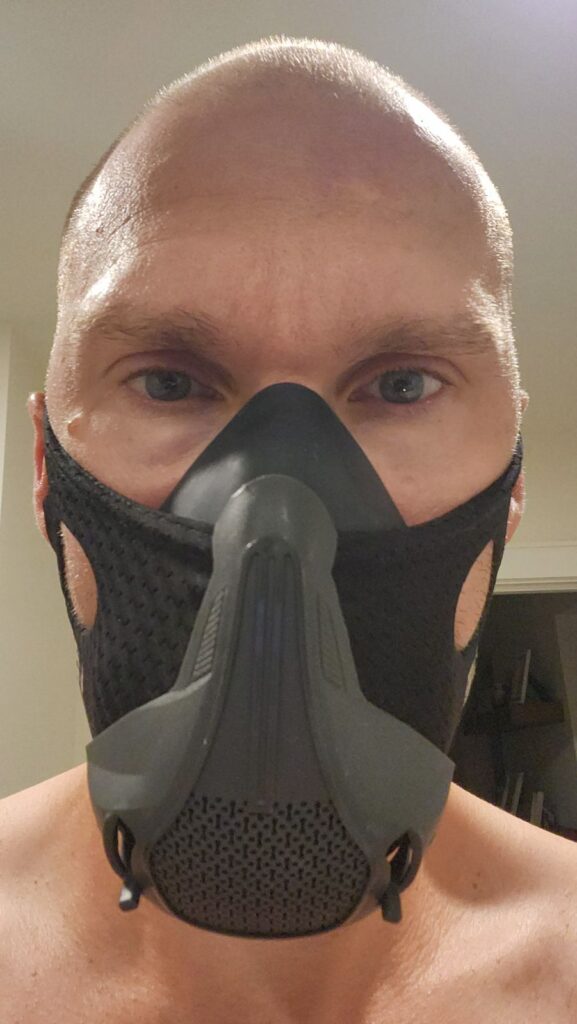
Ron wears the mask for about 2 minutes. I ask him to raise his arm. Ron whacks himself in the side of the head with his bicep. Full mobility restored.
I send Ron home confident in the fact that he has the best trainer of all time (he does btw).
The next week comes around. I see Ron. I ask him, ‘so did you buy yourself an O2 deprivation mask?’
No.
Thank you folks for tuning in to another episode of ‘You can Lead a horse to water…’
IN SUM
The average adult breaths from 10-20 times a minute. Ask yourself- do I want to be someone who breathes slowly and purposefully every 12 seconds? Or do I want to breath in and out rapidly every 3 seconds?
Breathing is a skill. Practice creates improvement. You can practice by sitting and breathing slowly; or by gradually increasing your cardio-vascular workouts; or by breathing in and out of your nose solely.
Just think- you may have been running around your whole life on a half empty tank. Let’s fill it up. No telling what you’re capable of now.